
You see the word “caption” on photos, movies, and social media posts. It looks simple, but it has more than one meaning. The meaning changes with the setting.A caption is a short text that explains or goes with a picture, video, or document. It can also be a heading or a legal title.
As a verb, to caption means to add that text.This guide explains each meaning in simple words. You will learn where the word came from, how to use it, and how it differs from similar terms. Read on and understand captions with ease.
Quick Answer: What Does Caption Mean?
A caption is a short piece of text that explains or goes with a picture, video, or document. It can be the words under a photo, a heading on a page, or on screen text in a film. As a verb, to caption means to add that text.
At a Glance Summary
| Question | Short Answer |
| Part of speech | Noun and verb |
| Main meaning | Text that explains a picture |
| Other meanings | Heading, film text, and a legal heading |
| Verb form | Captioned, captioning, captions |
| Origin | Latin captio, from capere, “to take” |
| Close synonyms | Legend, cutline, title, subtitle |
What This Guide Covers
- All main meanings of caption
- Word origin and history
- Noun and verb use with examples
- Caption vs similar words
- Tips for writing a good caption
The Main Meanings of Caption
Dictionaries list several senses of the word. Merriam-Webster includes the heading of an article or document, the explanatory comment with a picture, a movie or TV subtitle, and a legal part of a document that shows where, when, and by what authority it was taken or executed.
Dictionary.com adds a modern sense. It describes a caption in film and video as a written version of dialogue plus other audio like music and sound effects, shown on the screen.
| Meaning | Plain Explanation | Example |
| Picture text | Words that explain an image | The caption named everyone in the photo |
| Heading | A title for a page, chapter, or article | The caption above the chart said “Sales by Year” |
| Screen text | Text shown on video for dialogue and sounds | Turn on captions to follow the show |
| Legal heading | The top part of a legal paper that names the parties and court | The caption of the filing listed the court |
| Social post text | The words you write under a post | She wrote a funny caption for her selfie |
Where Does the Word Caption Come From?
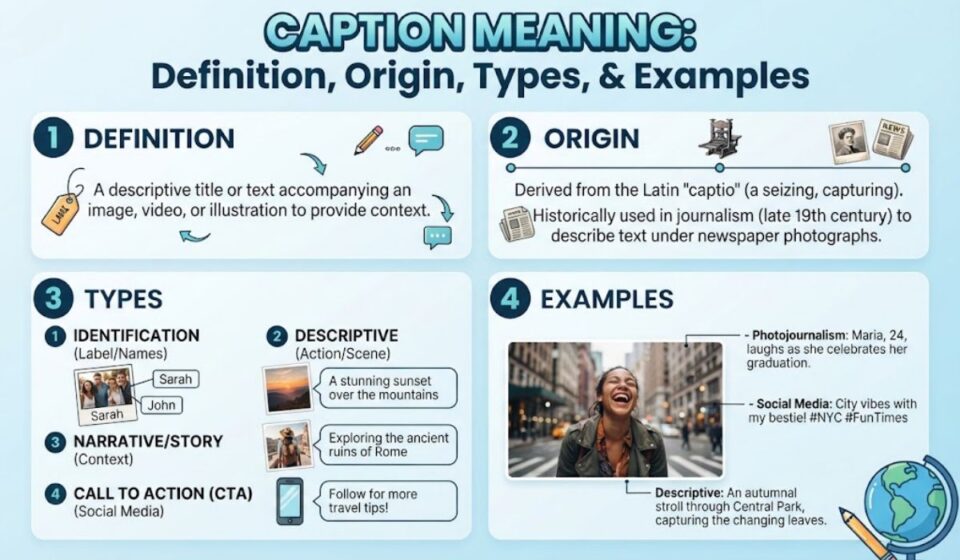
The word has an old and surprising story. It comes from Latin captio, which is linked to capere, meaning “to take” or “to seize.” That is the same root that gave us words like “capture.”
In Middle English, “caption” first meant a taking, seizure, or arrest. Later, it described the heading of a legal document that told where, when, and by whose authority something was done. From that legal heading, the word grew into the general idea of a heading or title, and then into text that goes with a picture.
The word spread slowly into everyday use. Dictionaries date the noun to around 1670, and the verb “to caption” to 1848. Today most people know it from photos, TV, and social media.
| Stage | Meaning of the Word |
| Latin | captio, an act of taking |
| Middle English | A seizure or arrest |
| Legal use | The heading of a legal paper |
| Print era | A heading or title |
| Modern use | Text with a picture, video, or post |
Caption as a Noun and as a Verb
Caption works in two ways. As a noun, it names the text. As a verb, it describes the act of adding that text.
Caption as a Noun
- “Read the caption under the photo.”
- “The caption on the chart explains the colors.”
- “I need a good caption for this post.”
Caption as a Verb
To caption something means to supply it with a caption. The forms are caption, captions, captioned, and captioning.
- “She will caption each drawing.”
- “He captioned the photo with a joke.”
- “We are captioning the video today.”
| Word Form | Example |
| Caption | Add a caption to the image |
| Captions | The captions are easy to read |
| Captioned | The photo was captioned “Day One” |
| Captioning | Captioning takes practice |
Types of Captions
Different fields use captions in different ways. Knowing the type helps you pick the right style.
| Type | Where It Appears | Purpose |
| Photo caption | Newspapers, books, websites | Names people, places, and context |
| Figure or table caption | Reports and research papers | Explains data and charts |
| Closed or open captions | TV, film, online video | Show speech and sounds as text |
| Social media caption | Instagram, Facebook, TikTok | Adds voice, humor, or a call to action |
| Legal caption | Court filings | Names the parties, court, and case number |
| Cartoon caption | Comics and cartoons | Delivers the joke or message |
Video Captions in More Detail
Video captions deserve special mention. They help viewers who are deaf or hard of hearing, and they help anyone watching without sound. Good captions include speaker names and sound cues, not just words.
Social Media Captions
On social apps, a caption is the text you write with your post. It sets the tone, adds context, and can invite comments. Short and clear captions often work best.
Caption vs Similar Words
Many words sound close to “caption.” They are related but not identical.
| Term | Meaning | How It Differs From Caption |
| Title | The name of a work | A title names the whole work. A caption explains one part or image |
| Headline | The top line of a news story | A headline summarizes a story. A caption supports a picture |
| Subtitle | Text that translates or shows spoken words | Subtitles are for language help. Captions also show sounds |
| Legend | Another word for a picture caption | Often used for maps and charts |
| Cutline | A newspaper term for a picture caption | Same idea, used in news work |
| Label | A short name on an item | A label is shorter and names, not explains |
| Alt text | A text description for screen readers | Alt text is hidden, and captions are visible |
| Transcript | A full written record of speech | A transcript is separate from the video |
Dictionaries also list legend, cutline, subtitle, and translation as synonyms in different senses. The best choice depends on the setting.
Caption Examples by Situation
Examples make the meaning easier to remember. These are original samples.
| Situation | Sample Caption |
| News photo | “Volunteers plant trees along the river bank on Saturday.” |
| Science chart | “Figure 2: Average rainfall by month.” |
| Family photo | “Grandma’s 80th birthday, surrounded by her grandchildren.” |
| Travel post | “Sunrise made the early alarm worth it.” |
| Video | “[upbeat music] Welcome back to the show.” |
| Cartoon | “I told you not to feed the robot.” |
How to Write a Good Caption
A good caption is clear, short, and useful. It adds something the picture cannot say on its own. Follow these steps.
- Know your purpose. Do you want to inform, entertain, or sell?
- Describe what matters. Name people, places, and key details.
- Add context. Explain why the image matters.
- Keep it short. One or two sentences is often enough.
- Match the tone. News captions are factual, and social captions can be playful.
- Check facts and spelling. Errors make the image look careless.
- Make it accessible. For video, include sound cues and speaker names.
Caption Length Guide
| Use | Best Length |
| News photo | 1 to 2 sentences |
| Report figure | 1 short line |
| Social media | A short hook plus a line or two |
| Video | Short lines that match the pace of speech |
Common Mistakes and Do’s and Don’ts
Even simple captions can go wrong. Avoid these common errors.
Common Mistakes
- Repeating what the image shows. Say something new.
- Leaving out names. Readers want to know who is in the picture.
- Being too long. Long captions lose attention.
- Mixing up caption and subtitle. They are not the same.
- Skipping sound cues in video captions. Viewers lose context.
- Forgetting alt text. Screen reader users need it too.
Do’s and Don’ts
| Do | Don’t |
| Add facts, names, and context | State the obvious |
| Keep it short and clear | Write a long paragraph |
| Match tone to the setting | Use jokes in serious news |
| Proofread before publishing | Publish typos |
| Add alt text and video captions | Rely on color or visuals alone |
Frequently Asked Questions
What does caption mean?
A caption is text that explains or goes with a picture, video, or document.
Is caption a noun or a verb?
Both. As a noun it names the text. As a verb it means to add that text.
Where does the word caption come from?
It comes from Latin captio, linked to capere, “to take.” It first meant a seizure.
What is a caption in a video?
It is on screen text that shows speech and key sounds, often for viewers who cannot hear.
What is the difference between a caption and a title?
A title names the whole work. A caption explains a picture or part of it.
What is a caption on social media?
It is the text you write under your photo or video post.
What is a legal caption?
It is the heading of a legal paper that names the parties, court, and case details.
Conclusion
The caption meaning is simple at its core: text that explains or goes with something. But the word wears many hats. It can be a picture note, a heading, screen text for video, a social post line, or a legal heading.
The word itself has a long history, from a Latin root meaning “to take” to the everyday use we know today. When you write a caption, keep it clear, accurate, and useful. Add facts the image cannot show, match your tone to the setting, and always proofread.