
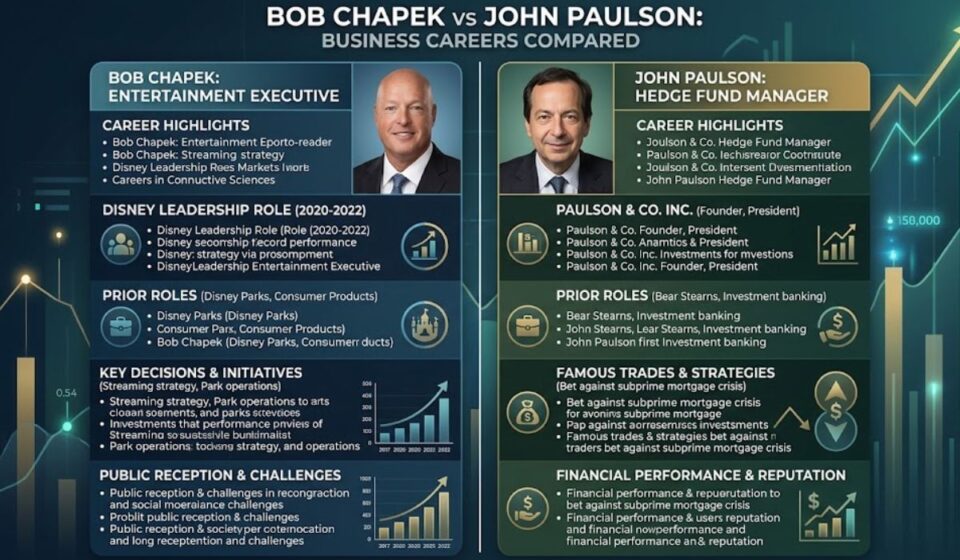

Bob Chapek and John Paulson are both well known in business. Yet their careers look very different. One spent decades inside a giant entertainment company and rose to run it. The other built his own investment firm and made one of the most famous trades in Wall Street history.
This guide puts the two careers side by side. You will see how each man started, what he did best, and where things got hard. You will also learn why a corporate chief executive and a hedge fund founder do such different work, even though both carry the word “leader” in their story.
Bob Chapek’s career at Disney
Bob Chapek spent most of his working life at one company. He joined The Walt Disney Company in 1993. His first job was in marketing for home video. That was a long way from the top, but it gave him a close look at how Disney sells its stories to families.
He did not stay in one lane. Over the years he moved through several parts of the business. From 2006 to 2009 he led film distribution for Disney’s studio. After that he took charge of Disney Consumer Products, which covers toys, clothing, and other items linked to Disney characters. He later became head of the parks and resorts side of the business.
From home video to the parks
Chapek’s biggest stretch before the top job came in the parks division. In 2015 he took over the group that runs theme parks, resorts, cruise ships, and merchandise. This is a huge part of Disney. It brings in big revenue and touches millions of guests each year.
He was seen as a hands-on operator. He knew guests, prices, crowds, and costs. That practical record is a big reason the board saw him as a safe choice for the future.
Here is a quick look at his main steps:
| Period | Role or area | What it involved |
| 1993 | Home video marketing | Entry level marketing job at Disney |
| 2006 to 2009 | Studio distribution | Getting Disney films to theaters and partners |
| 2009 onward | Consumer products | Toys, apparel, and licensed goods |
| 2015 onward | Parks, experiences, and products | Theme parks, resorts, cruises, and merchandise |
| February 2020 | Chief executive officer | Led the whole company |
| November 2022 | Left the role | Board ended his time as CEO |
Becoming CEO during a crisis
In February 2020, Chapek took over from Bob Iger, who had led Disney for about fifteen years. Iger was popular. He had also guided Disney through major deals, including the purchases of Pixar, Marvel, Lucasfilm, and 21st Century Fox assets. Anyone following him would face high hopes.
The timing made it harder. Within weeks, the COVID-19 pandemic shut down parks, cruise ships, film sets, and live events. Disney’s money engine slowed sharply. Chapek had to steer the company through a crisis that no leader had planned for.
His time as CEO had real tasks and real tension:
- He kept the company running through park closures and reopenings.
- He pushed the company toward streaming, with Disney+ at the center of strategy.
- He reorganized the business so that one group handled distribution and sales across film, TV, and streaming.
- He raised prices and introduced paid add-ons at the parks, which upset many fans.
- He faced a public fight with Florida leaders over a state education law, and his response drew criticism from several sides.
How it ended
By autumn 2022, pressure had grown. Disney’s stock price had slipped. Investors worried about streaming losses. Some staff and fans were unhappy with his decisions and his public messages. On a Sunday in November 2022, the board announced that Bob Iger would return as CEO and that Chapek was out.
Chapek later told his side of the story in a memoir called Behind the Castle Walls, released in September 2026. In it, he looks back on thirty years at the company and asks whether he was given a fair chance. Readers can judge that for themselves. What is clear is that his career was one long climb inside a single company, ending at the very top and then ending suddenly.
John Paulson’s investment career
John Paulson took a different road. He did not climb one company’s ladder. He built his own firm and made his own bets. His name became famous because of a single, bold idea about the housing market.
Paulson was born in New York and studied business. He finished his MBA at Harvard Business School, graduating with top honors. His first job out of school was at Boston Consulting Group, where he gave advice to companies. Later he worked in mergers and acquisitions on Wall Street, including a stint at Bear Stearns.
Starting a hedge fund
In 1994, Paulson started his own firm, Paulson & Co. He launched it with about $2 million and almost no staff. He even rented office space from his former employer, Bear Stearns. The firm began with a focus on merger arbitrage, which means betting on how company deals will play out.
For years, the firm kept a low profile. Paulson did steady work, studied deals, and built a track record. Few people outside the industry knew his name. That changed in 2007.
The subprime trade
Paulson came to believe that many home loans in the United States were risky and that the bonds built from them were priced too high. He decided to bet against them. He did this mostly through credit default swaps, which work like insurance on a bond. If the bonds failed, the swaps would pay out.
He set up a special fund for this idea in 2006. When the housing market cracked, the bet paid off in a huge way. His firm earned about $15 billion in profit, and Paulson himself reportedly made around $4 billion. Many people call it one of the greatest trades ever.
The key points of this trade are easy to remember:
- The idea was simple: risky mortgages would fail.
- The tool was credit default swaps, which cost little compared with their possible payoff.
- The risk was limited, since the cost of the swaps was known in advance.
- The reward was enormous when the market turned.
Life after the big win
Success brought money and attention. It also brought pressure. Paulson’s funds grew to tens of billions of dollars at their peak, with figures often cited at more than $30 billion. But later bets did not match the first one. A large bet on gold and other calls produced mixed results, and some years brought heavy losses.
As clients pulled money out, the firm shrank. In 2020, Paulson returned outside investors’ money and turned the business into a family office. A family office manages the wealth of one family instead of many clients. His career moved from running other people’s money to managing his own.
| Period | Milestone | Why it matters |
| 1980 | Starts at Boston Consulting Group | First step in business after his MBA |
| 1994 | Founds Paulson & Co. | Begins with about $2 million |
| 2006 to 2007 | Subprime mortgage bet | Makes the firm world famous |
| Early 2010s | Peak size | Assets reach tens of billions |
| 2020 | Becomes a family office | Returns outside capital |
How their business roles differed
Chapek and Paulson both worked in business, but their daily jobs were nothing alike. One led thousands of employees and many product lines. The other made investment calls with a small team. Comparing them shows how wide the world of business really is.
Operator versus investor
Chapek was an operator. An operator runs a business and makes it work day after day. He had to think about guests, prices, staff, film schedules, streaming plans, and public image. Many choices were small, but they added up.
Paulson was an investor. An investor decides where to put money and when to take it out. His main task was to find prices that looked wrong and bet on the gap. He did not have to run theme parks or make movies. He had to see the market clearly and act on it.
Employee versus owner
Chapek was a salaried executive. He worked for a company owned by public shareholders. The board could hire him and fire him, and in the end it did. His power came from the job title, and the title could be taken away.
Paulson was the founder and owner of his firm. He set the strategy and kept a large share of the rewards. When the bet worked, he gained a great deal. When later bets failed, he also felt the pain. His fate was tied to his own choices, not to a board’s mood.
Side by side
This table shows the main differences at a glance:
| Area | Bob Chapek | John Paulson |
| Main role | Corporate executive and CEO | Hedge fund founder and investor |
| Employer | The Walt Disney Company | His own firm, Paulson & Co. |
| Career path | One company for about three decades | Consulting, Wall Street, then own firm |
| Key skill | Running a large business | Spotting mispriced markets |
| Source of power | Board appointment | Ownership and investor trust |
| Biggest win | Leading through a global shutdown | The subprime mortgage bet |
| Biggest setback | Removal as CEO in 2022 | Weaker results after the crisis |
| Team size | Tens of thousands of staff | A small group of analysts |
Risk and reward
The two careers also carried different kinds of risk. Chapek’s risks were public. Fans, investors, and politicians watched every move. A pricing change or a political comment could turn into a headline overnight.
Paulson’s risks were financial and private, until the results became public. He could be right for years and still look quiet. Or he could be wrong and lose clients quickly. Both men faced criticism at times. Neither found it easy to stay on top.
What readers can learn
There are a few useful lessons here for anyone who follows business careers:
- Timing matters. Chapek took the top job just before a global shutdown. Paulson placed his big trade just before a market crash.
- Context shapes results. A leader after a beloved CEO faces high expectations. A fund manager after a huge win faces the same.
- No role is risk free. An employee can lose a job. An owner can lose clients and capital.
- Different skills fit different paths. Running people and brands is not the same as reading markets.
Frequently Asked Questions
Who is Bob Chapek?
Bob Chapek is an American media executive who spent about three decades at Disney. He served as its CEO from February 2020 to November 2022.
Who is John Paulson?
John Paulson is an American hedge fund manager. He founded Paulson & Co. in 1994 and became famous for betting against subprime mortgages.
When did Bob Chapek become Disney CEO?
Chapek became CEO in February 2020. He took over from Bob Iger just before the COVID-19 pandemic began.
Why did Bob Chapek leave Disney?
Disney’s board ended his term in November 2022 and brought Bob Iger back. Concerns about the stock price, streaming losses, and public disputes were part of the backdrop.
How did John Paulson make his money?
He made most of it by betting against the U.S. housing market in 2007. His firm earned about $15 billion, and he reportedly made roughly $4 billion himself.
What is a family office, and did Paulson switch to one?
A family office manages the wealth of a single family. Paulson returned outside money and converted his firm into one in 2020.
What is the main difference between their careers?
Chapek ran a large company as an employee. Paulson owned his firm and made investment bets with his own team.
Final Thoughts
Bob Chapek and John Paulson show two very different ways to build a business career. Chapek rose step by step inside one company, from a home video marketing job to the CEO chair at Disney.
His story is about leading a huge organization in hard times and facing the limits of that power. Paulson started a small firm, took one bold idea, and turned it into a legendary trade. His story is about conviction, risk, and the harder task of repeating success.