
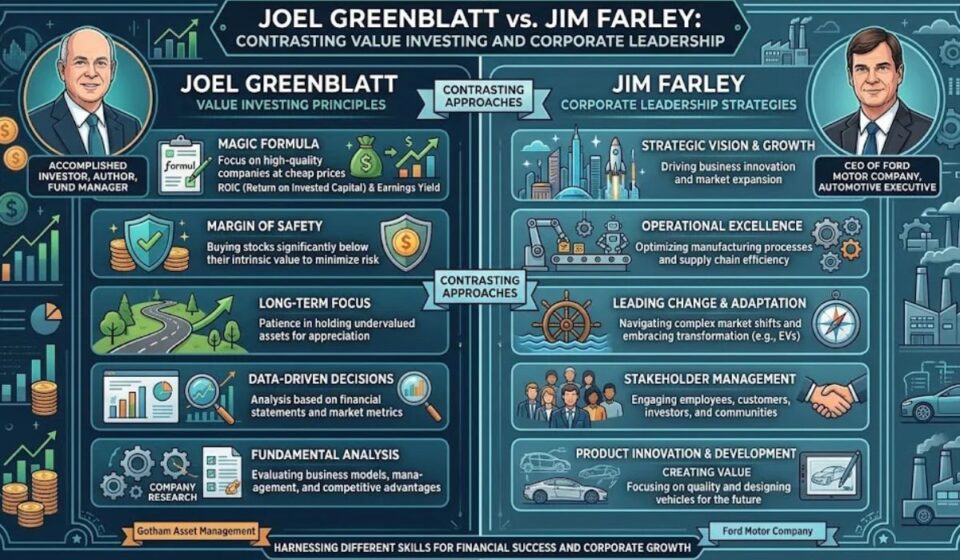

People often search for Joel Greenblatt and Jim Farley in the same breath. The names sound familiar, and both men sit near the top of the American business world. Yet they do very different jobs.
Joel Greenblatt is an investor, author, and teacher. Jim Farley runs one of the largest car companies in the United States. One picks stocks and explains how to value them. The other builds, sells, and services vehicles on a global scale.
This guide explains who each man is, what each is known for, and how their daily responsibilities compare. You will also find a quick comparison table, a set of common questions, and a source list.
Who is Joel Greenblatt?
Joel Greenblatt is an American value investor, hedge fund manager, professor, and writer. He was born on December 13, 1957, in Great Neck, New York. He earned his undergraduate degree at the Wharton School of the University of Pennsylvania. He also spent a year at Stanford Law School before leaving to work in finance.
In 1985, he co-founded Gotham Capital, a private investment partnership. Reports describe its results as roughly 40 percent a year for about two decades. That record made him one of the best known money managers of his generation. In 2008, Gotham Asset Management took over the advisory business of Gotham Capital.
Greenblatt is also a teacher. He began teaching value investing to MBA students at Columbia Business School in 1996. His course, called Value and Special Situation Investing, ran for more than twenty years. He often brought in working investors to speak with students.
Here are the main parts of his career at a glance:
- Investor: Co-founder and long-time leader of Gotham, now Gotham Asset Management.
- Teacher: Adjunct professor at Columbia Business School.
- Author: Wrote popular books on investing for both professionals and beginners.
- Entrepreneur: Founded the New York Securities Auction Corporation.
- Community builder: Co-founded the Value Investors Club, where investors share ideas.
- Board member: Served as chairman of the defense and aerospace firm Alliant Techsystems.
His books are a big reason ordinary readers know him. You Can Be a Stock Market Genius explored special situations such as spin-offs and mergers. The Little Book That Beats the Market turned his stock-picking method into a short, plain guide. Later titles aimed to help everyday savers invest with less stress.
His writing style is simple on purpose. He uses small examples and plain language. That is why many new investors start with his work before moving on to heavier textbooks.
What does his Magic Formula measure?
The Magic Formula is Greenblatt’s best known idea. It is a rules-based way to find good companies at fair prices. It looks at only two things: how cheap a stock is and how well the business earns money.
The first measure is earnings yield. This compares a company’s operating profit to its enterprise value. Enterprise value is the market value of the shares plus debt, minus cash. A higher earnings yield means you pay less for each dollar of profit.
The second measure is return on capital. This shows how much operating profit a company makes from the money tied up in its business. In the standard version, the base is net working capital plus net fixed assets. A higher number points to a strong, efficient business.
The method then ranks stocks on both measures and adds the two ranks together. The stocks with the best combined scores rise to the top. Investors who follow the plan usually buy a basket of about 20 to 30 of them. They hold the shares for about a year and then repeat the process.
| Measure | What it shows | Simple meaning |
|---|---|---|
| Earnings yield | Operating profit compared to enterprise value | Is the stock cheap? |
| Return on capital | Operating profit compared to capital used | Is the business good? |
| Combined rank | Both scores added together | Which stocks look best overall? |
The rules also remove some types of firms. Banks, insurers, and utilities are commonly left out because their numbers work differently. Very small companies are often skipped too.
One point matters a lot. The formula does not promise profit every year. Cheap stocks can stay cheap for long stretches, and some years will lag the market. The method asks for patience and discipline more than clever timing.
Who is Jim Farley?
Jim Farley is the president and chief executive officer of Ford Motor Company. His full name is James Duncan Farley Jr. He was born on June 10, 1962. He studied economics at Georgetown University and later earned an MBA, according to public profiles.
Cars run in his family. His grandfather worked at Ford’s historic River Rouge plant, and his father also worked in the industry. Farley has said he stays in autos because the business is a hard problem to solve, not only because he loves vehicles. He is also a keen racer.
Before Ford, he spent years at Toyota. He worked in sales and marketing roles and helped launch the Scion brand, which targeted younger buyers. He later became group vice president and general manager of Lexus, the company’s luxury brand. That role covered sales, marketing, and customer satisfaction.
Farley joined Ford in November 2007. He took over as CEO on October 1, 2020, after Ford announced the change in August of that year. He succeeded Jim Hackett, who stayed on for a time as a special advisor. Farley also sits on the board of Harley-Davidson.
As of late 2026, public records still list him as Ford’s chief executive. He has led the company for more than five years. Those years included electric vehicle launches, supply chain shocks, and a fast-changing market.
He is known as a hands-on, product-focused leader. He talks openly about quality, costs, and customer experience. He also speaks often about the future of work and technology.
How did Farley’s Ford career develop?
Farley did not start at the top. He moved through several large jobs at Ford before becoming CEO. Each role gave him a wider view of the business.
He first led marketing and brand work after joining in 2007. Around 2015, he became executive vice president and president of Ford’s Europe, Middle East, and Africa region. That job meant running a full regional business with its own factories, dealers, and customers.
He then led Ford’s global markets and, after that, its new businesses, technology, and strategy group. This work pushed him toward electric, connected, and self-driving vehicles. It also put him in charge of how Ford tests new ideas.
In March 2020, he became chief operating officer. In that role, he oversaw product development, purchasing, manufacturing, and labor affairs. Six months later, he was named CEO.
| Stage | Role | Main focus |
|---|---|---|
| 2007 | Joined Ford from Toyota | Marketing and brand work |
| About 2015 | President, Europe, Middle East, Africa | Regional business and profit |
| Later years | President, global markets | Sales across the world |
| Later years | President, new businesses, technology, and strategy | New tech and mobility |
| March 2020 | Chief operating officer | Product, purchasing, manufacturing |
| October 2020 | President and CEO | Company-wide leadership |
As CEO, he introduced the Ford+ plan. It aims to grow the business by focusing on customers, new technology, and long-term value. Ford has since split its work into groups that handle gas vehicles, electric vehicles, and commercial customers.
How do their professional responsibilities compare?
The simplest way to compare them is to ask what each person is paid to decide. Greenblatt decides where money should go. Farley decides how a large company should make and sell products.
Greenblatt’s work is about capital. He studies businesses from the outside, judges price against value, and builds portfolios. His main tools are financial statements, ranking models, and long-term discipline. He does not run the day-to-day operations of the companies he owns.
Farley’s work is about operations. He leads a workforce of tens of thousands. He answers to a board and to shareholders. His choices touch factories, supply contracts, product design, labor talks, pricing, and safety.
Their results are measured differently as well. An investor is judged by returns over time. A CEO is judged by sales, profit, product quality, and the health of the company’s brands.
There is one useful link between them. Greenblatt’s formula might screen a carmaker like Ford, along with thousands of other firms, based on its profit and capital. Farley’s choices on cost, quality, and product mix would feed into the very numbers that formula reads. One studies the scoreboard. The other plays the game. This is only an example of how the roles connect, not a claim that the two work together.
| Area | Joel Greenblatt | Jim Farley |
|---|---|---|
| Main field | Investing and education | Automotive manufacturing |
| Core job | Allocating capital | Running a global company |
| Key organization | Gotham Asset Management | Ford Motor Company |
| Famous for | The Magic Formula and value investing books | Leading Ford since 2020 |
| Daily decisions | Which stocks to own and when | Products, costs, plants, and strategy |
| Who he answers to | Fund investors | Ford’s board and shareholders |
| Teaching role | Columbia Business School | None as a core duty |
| Success measure | Long-term investment returns | Sales, profit, and product quality |
| Public voice | Books, lectures, interviews | Earnings calls, media, and speeches |
Here are the key differences in plain terms:
- Scale of people managed: Greenblatt leads an investment firm. Farley leads a global workforce.
- Type of risk: Greenblatt takes market risk. Farley takes operating and product risk.
- Time horizon: Greenblatt thinks in market cycles. Farley plans in vehicle cycles of several years.
- Visible output: Greenblatt produces returns and books. Farley produces cars, trucks, and software.
So the answer to the main question is clear. Both are respected leaders, but they work on opposite sides of business. One allocates money. The other builds the product that money is invested in.
Frequently Asked Questions
Who is Joel Greenblatt?
Joel Greenblatt is an American value investor, author, and Columbia Business School teacher. He co-founded Gotham Capital in 1985 and created the Magic Formula.
Who is Jim Farley?
Jim Farley is the president and CEO of Ford Motor Company. He has held the top job since October 2020.
What is the Magic Formula in investing?
It is a rules-based stock method that ranks companies on earnings yield and return on capital. The best combined scores are the ones an investor buys.
Is Jim Farley an investor like Joel Greenblatt?
No. Farley is a corporate executive who runs Ford, while Greenblatt invests and manages money for others.
Did Jim Farley work at Toyota before Ford?
Yes. He worked at Toyota, including a leadership role at Lexus, before joining Ford in November 2007.
Which books did Joel Greenblatt write?
His best known titles are You Can Be a Stock Market Genius and The Little Book That Beats the Market. He also wrote later books for everyday investors.
Do Joel Greenblatt and Jim Farley work together?
No public source shows a formal partnership between them. They work in different industries and have separate roles.
Final Thoughts
Joel Greenblatt and Jim Farley are both influential, but they are not in the same line of work. Greenblatt is known for value investing, teaching, and a simple formula that ranks stocks by price and quality. Farley is known for leading Ford through a period of heavy change in the auto industry.
If you remember one idea, make it this one. Greenblatt studies businesses and decides what to buy. Farley runs a business and decides what to build. Understanding that split makes it easier to read news about either man and to see why their jobs call for very different skills.