
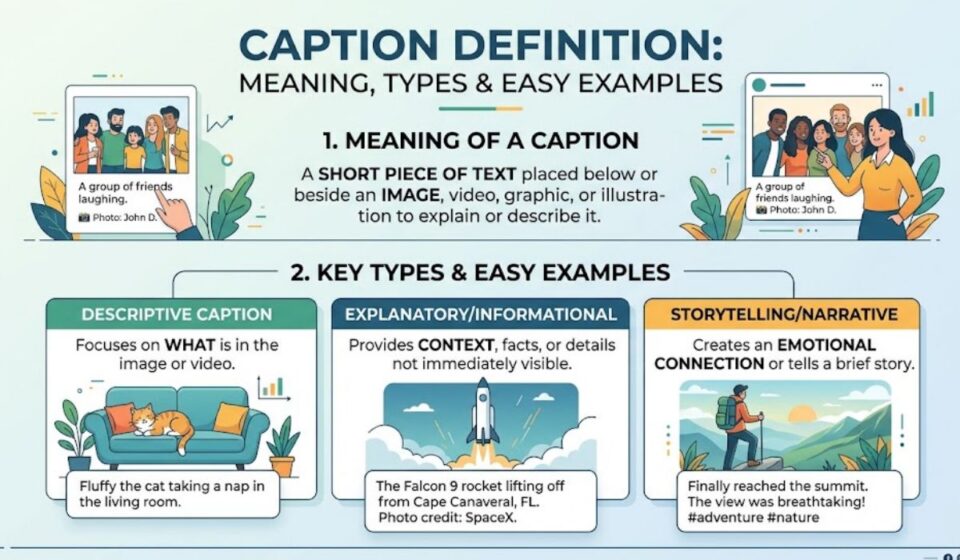

You see captions every day. They appear under photos, on videos and in social media posts. Yet many people are not sure what the word really means.A caption is a short text that goes with a picture or video. It explains what you see and adds feeling to the moment.
Captions also help people who cannot hear a video, which makes content easier for everyone.This guide explains the caption definition in simple words. You will learn where the word comes from and the main types of captions. You will also see easy examples you can use right away.
What Is the Meaning of Caption?
A caption is a short piece of text that goes with a picture, video or other visual. It explains, describes or adds feeling to what you see. In simple words, it tells the viewer what they are looking at.
Captions can be one line or a few lines. They can be serious, funny or emotional. The tone depends on the image and the audience.
A caption also has another meaning in video. There, it means text on screen that shows the spoken words. Deaf and hard of hearing viewers depend on it. Many other people use it too, such as those watching in a noisy place.
Dictionary Definition of Caption
Most dictionaries give a few related meanings. Here are the common ones:
- A title or short heading above an article, chapter or page.
- A line of text under a photo, drawing or chart.
- Text shown on a screen that matches the audio of a video.
- A short message written with a social media post.
All these meanings share one idea. A caption supports the main content. It never replaces it.
Origin of the Word Caption
The word comes from the Latin word captio. It is linked to the verb capere, which means to take or to seize. In old English, a caption was the heading of a legal paper. It showed where and when the paper was made.
Over time, the meaning shifted. Printers began to use the word for titles and headings. When newspapers started printing photos, the word moved to the text under them. Today it covers almost every short note that goes with a visual.
Main Types of Captions
Captions come in many forms. Each type serves a different purpose. The table below shows the most common ones.
| Type of Caption | Where It Appears | Purpose |
| Photo caption | Newspapers, magazines, websites | Explains who, what, where and when |
| Social media caption | Instagram, Facebook, X, LinkedIn | Adds a message, mood or call to action |
| Video caption | YouTube, films, online courses | Shows spoken words as text |
| Figure caption | Books, reports, research papers | Describes a chart, table or image |
| Image alt caption | Websites and apps | Helps screen readers describe an image |
| Meme caption | Memes and online jokes | Adds humour to a picture |
Caption in Photography and Journalism
In news, a caption has a clear job. It tells the reader the facts behind a photo. A good news caption answers who is in the picture, what is happening, where it is and when it took place.
Accuracy matters most here. A wrong name or date can harm trust. Editors check every caption before it goes to print.
Photo captions are also kept neutral. They state facts and avoid opinions. This keeps the reporting fair and clear.
Caption on Social Media
Social media captions work differently. They are often personal and creative. People use them to share a mood, tell a story or promote a product.
A strong social caption grabs attention in the first line. Most apps cut off long text, so the opening words matter. Many writers add a question, a hashtag or a call to action.
Brands use captions to build a voice. A bakery may write warm and playful lines. A law firm may write clear and formal ones. The caption shapes how people see the account.
Caption in Video: Captions and Subtitles
People often mix up captions and subtitles. They look alike, but they are not the same. The table below makes the difference clear.
| Feature | Captions | Subtitles |
| Main audience | Deaf and hard of hearing viewers | Viewers who speak another language |
| Spoken words | Yes | Yes |
| Sound effects | Yes, such as music or laughter | Usually no |
| Speaker names | Often included | Rarely included |
| Language | Same as the audio | Often translated |
Closed captions can be turned on or off. Open captions are part of the video and always show. Both help more people enjoy your content.
Caption in Books and Education
Textbooks use captions to teach. A caption under a diagram explains what each part means. A caption under a graph tells you what the numbers show.
Students often read captions before the main text. They give a quick summary of the idea. Good figure captions are short, clear and numbered, such as Figure 1 or Table 2.
Qualities of a Good Caption
A great caption is easy to read and useful. It fits the image and the audience. Keep these points in mind:
- Short: Use as few words as possible.
- Clear: Avoid hard words and long sentences.
- Relevant: Match the picture and its message.
- Accurate: Check names, dates and facts.
- Engaging: Add feeling, humour or a question where it fits.
- Accessible: Write for all readers, including those using screen readers.
How to Write a Caption Step by Step
Writing a caption is simple when you follow a plan. Start by looking closely at the image. Ask yourself what the viewer needs to know.
Then follow these steps:
- Decide the goal. Do you want to inform, entertain or sell?
- Know your audience. Write in a voice they enjoy.
- Write a first draft with the key facts.
- Cut every extra word.
- Add a hashtag or call to action if needed.
- Read it aloud and fix anything that sounds odd.
A good caption often takes only a few minutes. Practice makes it faster.
Caption Examples for Different Uses
Examples make the idea easy to grasp. Here are a few for common situations.
| Use | Example Caption |
| News photo | “Volunteers hand out food at a local shelter on Sunday.” |
| Travel post | “Sunrise over the mountains. Worth every early alarm.” |
| Food post | “Fresh, warm and gone in five minutes.” |
| Business post | “Meet our new team. We are ready to help you grow.” |
| Textbook figure | “Figure 1. The water cycle shows how water moves on Earth.” |
| Funny post | “Me trying to look calm on Monday morning.” |
Common Caption Mistakes to Avoid
Even simple captions can go wrong. Watch out for these errors:
- Repeating exactly what the image already shows.
- Writing long blocks of text under a small photo.
- Using too many hashtags or emojis.
- Forgetting to check spelling and names.
- Using a tone that does not fit the image.
A caption should add value. If it does not, rewrite it.
Frequently Asked Questions
What is the definition of caption?
A caption is a short text that goes with a picture, video or page. It explains or adds meaning to what you see.
What is a caption in simple words?
It is a few words that describe a photo or video. It tells the viewer what is happening or how the poster feels.
What is the difference between a caption and a subtitle?
Captions show spoken words and sounds for people who cannot hear well. Subtitles mainly translate speech into another language.
What is a caption on Instagram?
It is the text you write under your photo or video. It can include words, emojis and hashtags.
How long should a caption be?
Keep it short, usually one to three lines. Place the key message first because many apps cut long text.
What is the purpose of a caption?
A caption explains, supports or adds feeling to a visual. It also makes content easier to understand and find.
Where does the word caption come from?
It comes from the Latin word captio, linked to capere, meaning to take. It first meant the heading of a legal document.
Final Thoughts
A caption may be small, but it does a big job. It explains an image, shares a feeling and helps every viewer understand. Whether you read it in a news story, a textbook or a social post, the idea stays the same. A caption supports the visual and gives it a voice.
Now that you know the caption definition, you can write better ones. Keep them short, clear and true to the image. Know your audience and always check your facts. With a little practice, your captions will make every picture and video stronger.